

Facts Are Stubborn Things
Protest, Provocation, Peril, and Propaganda: 1770 and 2026

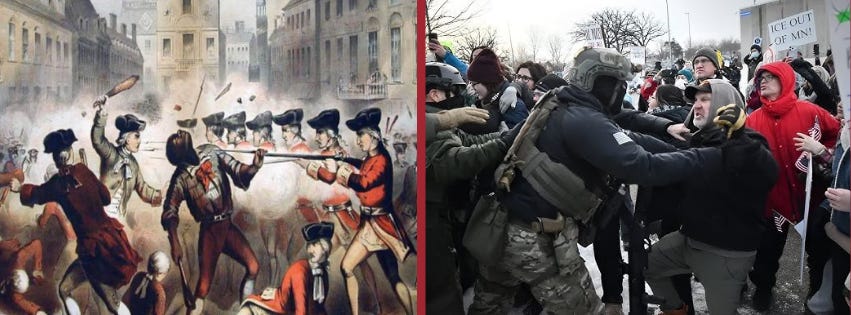
To begin with, a disclaimer: I am not an historian. I am not a journalist. Nor am I a lawyer or legal expert. This piece doesn’t propose a precise parallel between events in 1770 and events in 2026. In this piece, I’m making an observation. One that might be relevant and thought-provoking in this tense and volatile American moment. So here are my observations, for what they’re worth.
As I write this, a big snowstorm has enveloped New York City, so I’m stuck inside. I’ve been passing the time watching the myriad reports coming in about the most recent shooting of a protester by federal immigration agents in Minnesota. Despite the scraps of video captured by various bystanders at the scene yesterday, few confirmed facts are known about Mr. Alex Pretti’s actions, or of the actions of the agents who took him down in what appears—from those meagre scraps of video—to have been an unnecessary escalation and violent overreaction, resulting in Pretti’s death. Photos show Pretti holding up his own phone to capture what was happening to him; that video, when and if it comes to light, may provide much more information about the altercation and the shooting.
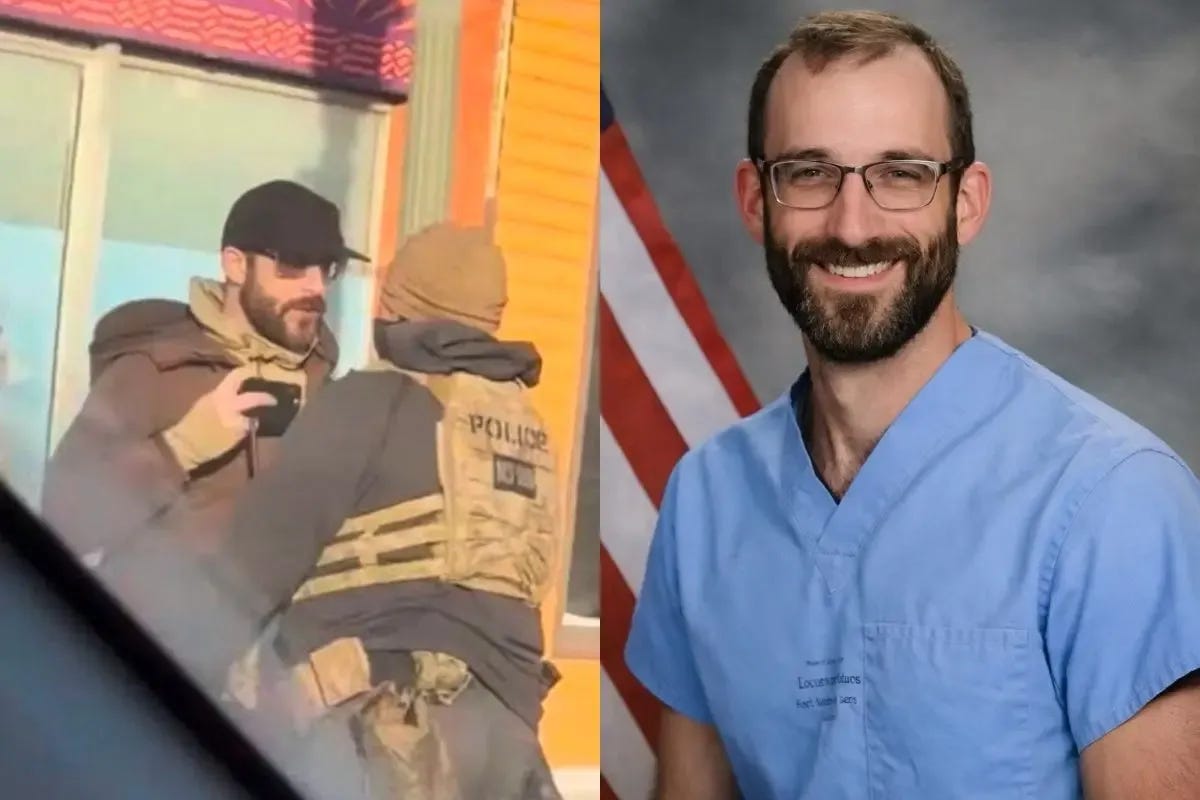
Today, the media shares affecting photos and videos of Pretti: at his high school graduation; yearbook pictures of him acting in school plays; smiling images of Pretti rock climbing, cycling. Video released by a grieving and grateful relative shows Pretti, alongside fellow ICU nurses at the VA Hospital where he worked, soberly delivering a final salute for a patient at their passing. "Today we remember that freedom is not free. We have to work at it, nurture it, protect it and even sacrifice for it," he says in the video. Stunning, even heartrending words—in light of the circumstances in which he met his own end. Clearly, Mr. Pretti was a person of conviction and a dedicated caregiver, serving our veterans as an agent of the government himself, while unafraid to demonstrate against that same government’s policies and actions.
As of this writing, we are about twenty-four hours from the incident, yet the spin on it from all sides, across all types of media, is breathtaking. I’ve spent this snowy morning watching reports and commentary from outlets on right and left; interpretations of the incident so diametrically opposed as to give one whiplash.
But actual FACTS? These are in short supply.
Officials and pundits on both sides, however, want us to believe in facts not yet in evidence. We know, for example, that Pretti was a licensed gun owner and had a permit to carry, but we do not know yet, for a fact, that he was carrying yesterday, or that he attempted to draw his weapon. Videos don’t show Pretti pulling a gun on the agents before they pepper spray him, tackle him to the ground and ultimately shoot him multiple times.
However, ABC News reports: “The Department of Homeland Security alleged that Pretti approached Border Patrol agents with a 9mm semi-automatic handgun, and “violently resisted” when agents tried to disarm him.” Self defense? “Border Patrol commander Greg Bovino declined to give more details about the confrontation, claiming, ‘This situation is evolving. The investigation is ongoing. Those facts will come to light.’”
Facts? Hmm.
Everett Kelly, the president of Pretti’s union, the American Federation of Government Employees, stated: "While details of the incident are still emerging, one fact is already clear: this tragedy did not happen in a vacuum. It is the direct result of an administration that has chosen reckless policy, inflammatory rhetoric, and manufactured crisis over responsible leadership and de-escalation." Which administration? Seems to me that the Trump administration, Governor Walz’s administration, and Minneapolis Mayor Frey’s administration have all engaged in reckless, inflammatory rhetoric and have done little to nothing to de-escalate the situation.
Facts. Again. Hmm.
“One fact is already clear.” Is it? In these times of spin, of left and right wing propaganda, mainstream news outlets misleadingly editing speeches and interviews, AI deep fakes, YouTubers posing as journalists, journalists behaving like activists, government officials posturing and promoting themselves as TikTok influencers, and folks on right and left perpetually inflamed and stirred up by a steady diet of outrage served up by their narrow, partisan algorithms…NOTHING IS CLEAR.
Come back with me now to another American moment of civil unrest and conflict in deep winter, when propaganda played a huge role after a clash between protesters and military forces. Boston, 1770. Mounting tension between American colonists and British authorities have led to a significant number of British troops being stationed in the city—a decision that many colonists viewed as an occupation. Protests directed against crown officials and British loyalists were becoming a regular occurrence.
On February 22, a mob gathered outside the home of customs officer Ebenezer Richardson, shouting and throwing stones at the windows. Twelve year-old Christopher Seider was amongst the protesters. He was killed when Richardson, fearing the violent mob, shot his gun at random into the crowd. Revolutionary Samuel Adams and his Sons of Liberty arranged for the boy’s funeral, which was attended by more than two thousand people. The outrage fueled by Seider’s killing would peak eleven days later, in an event that would change the course of history.
On the snowy evening of March 5, tensions boiled over on King Street, when Private Hugh White, a British sentry, became involved in a confrontation with local colonists outside the customs house. As more civilians gathered, the situation escalated. The crowd spat at White and shouted insults, hurling snowballs, ice, and other debris at him. Seven soldiers came to his aid, along with their commanding officer, Captain Thomas Preston. The mob surrounding them was now three hundred strong, some bearing clubs, shouting Fire!, and daring the soldiers to discharge their weapons. Amidst the chaos and confusion, one of the privates was struck and knocked down. Impulsively, he fired into the crowd. Although no order from Preston had been given, the other soldiers discharged their muskets, shooting eleven men. Five were killed, among them one of the leaders of the protest, a freed slave named Crispus Attucks.
Patriot leaders quickly shaped the event into a powerful piece of anti-British propaganda, using it to inflame colonial opinion and unify resistance. They organized public commemorations, circulated printed accounts, and used rhetoric that emphasized martyrdom and sacrifice. Samuel Adams played a central role in controlling the narrative. As a skilled political organizer and writer, he emphasized the massacre as deliberate murder rather than a chaotic street clash. Adams portrayed British soldiers as instruments of tyranny who had fired intentionally on innocent, defenseless colonists.
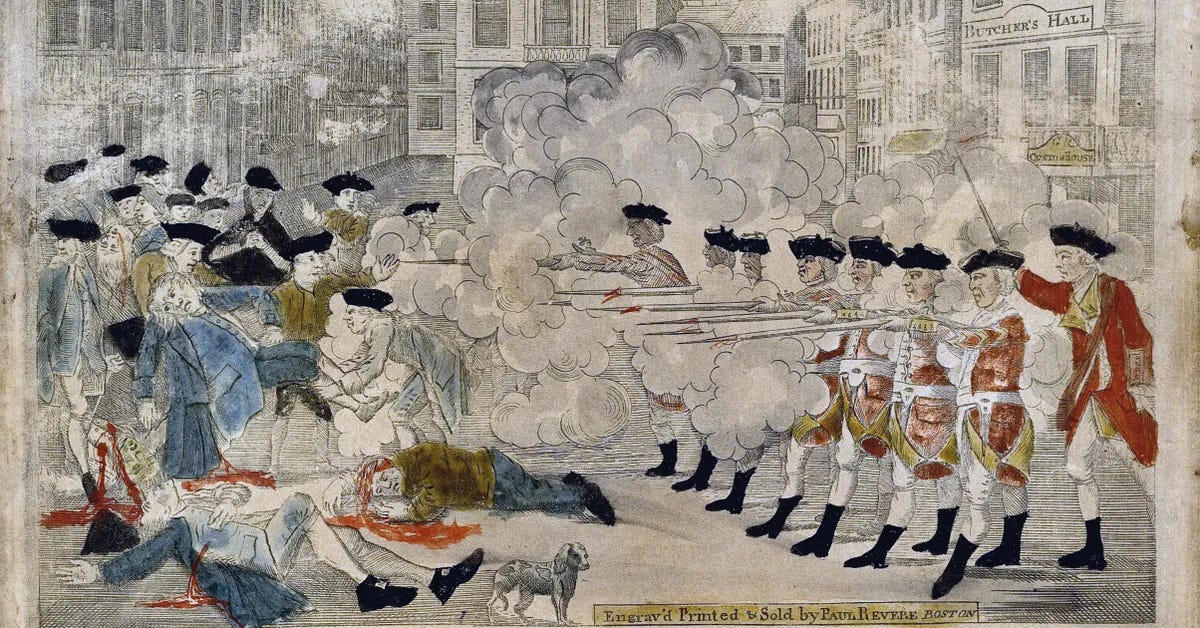
Paul Revere, another of the Sons of Liberty, reinforced this message visually with the famous engraving of the event, widely circulated under the title The Fruits of Arbitrary Power, or The Bloody Massacre. The image depicted British soldiers lined up in disciplined formation, their captain raising his sword, giving the command to fire into an unarmed crowd of helpless civilians. The depiction, of course, omitted the colonists’ role in instigating and escalating the confrontation and the dark, snowy, chaotic scene. This one image fixed a dramatic and misleading version of the event in the public imagination.
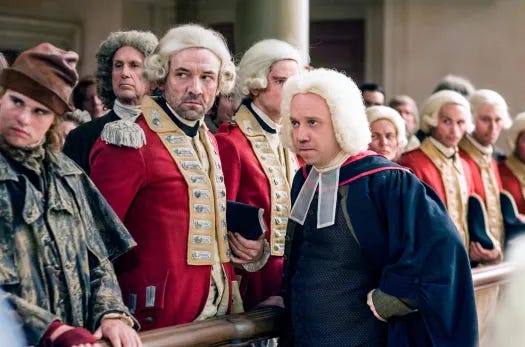
British authorities arrested the soldiers involved, and later that year they were put on trial for murder, with colonists, led by the Sons of Liberty and Samuel Adams, baying for blood. The prosecution argued that the British soldiers were criminally responsible for an unlawful and deliberate killing, not victims acting in self-defense, and therefore guilty of murder. Josiah Quincy II took on the soldiers’ defense, seeking out the most esteemed legal mind in the colony to lead the case—Samuel Adams’s cousin, founding father and one of my personal heroes, John Adams. Adams took the case out of his resolute commitment to the rule of law. Even though the victims were colonists and the defendants British soldiers, Adams argued that justice required impartial treatment. Defending unpopular defendants, he believed, demonstrated that colonial society was governed by law rather than mob rule.
Adams argued first that the soldiers had acted in self-defense. He presented testimony showing that the crowd had aggressively surrounded the soldiers, shouting threats and throwing snowballs packed with ice, clubs, and other debris. In this chaotic and dangerous situation, Adams contended, the soldiers reasonably feared for their lives. If they believed they were about to be seriously harmed, the law allowed them to use deadly force. He emphasized the confusion of the moment: there was no clear, coordinated order to fire and the shots resulted from panic amid noise, darkness, and disorder. This undermined the prosecution’s claim of premeditated murder and supported the idea that the killings were accidental or the result of fear rather than intent.
Most importantly, Adams insisted on strict adherence to the rule of law. He famously maintained that facts and evidence must prevail over emotion and public outrage, with these words:
"Facts are stubborn things; and whatever may be our wishes, our inclinations, or the dictates of our passion, they cannot alter the state of facts and evidence.”
Finally, Adams acknowledged that the soldiers’ actions were not blameless, but distinguished between murder and manslaughter. His reasoning helped persuade the jury to acquit most of the soldiers while convicting two of manslaughter, a verdict that reflected excessive force without malicious intent. In Adams’s view, the trial proved that liberty depended not only on resistance to tyranny but also on a commitment to fair trials and legal principles—even in the face of intense political pressure. In later years he would write:
"It was one of the most gallant, generous, manly and disinterested actions of my whole life, and one of the best pieces of service I ever rendered to my country."
We still do not know what really happened yesterday between Alex Pretti and those federal agents in Minnesota. We still do not know all the facts about what transpired in the few seconds between Jonathan Ross’s command to Renee Good to step out of her vehicle, Good stepping on the gas, and Ross firing the fatal shots. There’s been no trial yet in either case, and even though we’re flooded with various accounts and narratives, scraps of video interpreted in myriad ways, and though the cries of public outrage and justifiable sympathy for Pretti, Good and their families ring out on all sides…facts are stubborn things. We need the facts. Even when we have them, we will have to grapple with the human errors, split-second emotional reactions, and the bad choices—many of them made with the best intentions—that led to these tragedies.
Were Renee Good and her wife really peaceful protesters or were they radicalized agitators? Should they have complied with the orders of law enforcement, instead of taunting them and then driving their vehicle at them? Was Ross really in danger? Was he acting in self defense? Or was his overreaction due to reported PTSD from his extensive combat experience, and an alleged prior incident when he was hit by a car? If so, should he have even been working with I.C.E.? Was Alex Pretti carrying a gun yesterday, and did he actually threaten to use it? Did he, in a moment of high emotion, piss off some stressed out officers who overreacted? Are I.C.E., and the powers issuing them their orders, really evil, jack-booted, racist thugs occupying American cities? Are the protesters high-strung, misguided useful idiots, or highly organized, paid agitators shipped in to gin up the conflict and escalate a popular uprising, or even an overthrow of the government?
We need FACTS.
I’ve seen the same video footage you’ve seen: I.C.E. agents dragging people out of homes and businesses, picking up people in Home Depot parking lots and driving them away. Blatant racial profiling; aggressive, violent tactics being employed against protesters. I’ve also seen protesters doing way more than exercising their First Amendment right to protest—throwing things at officers, setting fires, beating agents with shovels and bats, dragging them under cars, vandalizing official vehicles, breaking into them and looting the weapons they contain; the death threats and doxing of law enforcement officers and their families. Like the mob on King Street in March, 1770, are they understandably upset, yet violent aggressors? And are the knee-jerk deadly reactions of triggered law enforcement acts of self defense, such as John Adams argued on behalf of Captain Preston and his men?
The two situations share a core dynamic — citizens in confrontation with armed government agents, leading to violence, public protest, and debate over the legitimacy of force. Of course, they differ in historical context, legal framework, and societal structure. Perhaps drawing parallels can help illuminate how we perceive matters of state power, public resistance, and contested authority, while also recognizing that the specific circumstances and implications in 1770 and 2026 are quite different. Both events saw dual narratives — one emphasizing lawful defense, the other depicting unjustified violence. In both eras, what people believed depended heavily on which narrative they encountered and trusted—and the propaganda machine kicked into high gear, escalating and influencing events.
We must do today what John Adams did in 1770. We must seek to uphold the rule of law, pursue the truth diligently, and remember that whatever may be our wishes, our inclinations, or the dictates of our passion, they cannot alter the state of facts and evidence. We need FACTS. They’re stubborn things.
Like you, I have a great and deep love for John Adams.
It is very important that the facts are properly investigated and the rule of law adhered to. To do anything less is to give comfort to America's enemies and detractors.
It is not very exciting and playing armchair detective is great but really detailed forensics takes many man hours.
In the meantime both sides should be seeking to lower the temperature.
For one thing, a bit in the same the BLM protests took the attention away from the Hong Kong Democracy protestors, the intense focus on what is now a legal matter takes the attention away from the over 30k killed, most likely on a shoot to kill order from Khamenei (according to info obtained by the Institute for the Study of War). Taking the focus away from the excesses of this failing and murderous regime gives them yet again a free pass. What happened in the immediate aftermath of the Iranian Revolution was dreadful. Iran A Modern History -- a weighty tome of a book but really important. Having the media focus on these protests means the massacre of thousands gets overlooked (The BBC are very bad on this)
And the whole 'giving the police/law enforcement' no good options in terms of protesting leads to this sort of thing. It is what the hard left extremists want. In the UK, nearly 100 Palestine Activists were arrested at the weekend when they stormed a jail and refused to leave. Needless to say the police took a dim view of the action. Palestinian Action said it was 'peaceful protest'/
There does need to be better training and lessons must be learnt for ICE because these sorts of on the edge of violence protests will continue and that means the possibility of continued tragedy. They need to plan for it and show restraint, even in the face of extreme provocation.
There should also be a reasoned debate on the need for reform of the immigration system in the US -- this debate should have happened in the 1970s (I grew up in California, a border state). The entire system is creaking and has been for a long time but successive governments duck the issue.
100% with ya--loved this "peace" an' I too admire the clear-headed-ness an' deep morality of John Adams. While ICE appears ta play their Kaiser Roll inna non-kosher-style ham-fisted manner (which don't win friends), the screedin' protest-turds need their heads eggs-ham-in'd too.
It's totally a FAFO sit-chew-ayshun... By all means protest--in the park, with a permit, gather as MANY ya want but ta approach armed OfficeSourds is risky.... Heck, I didn't even do dat in Brooklyn when I needed HELP!--An' old "persuader" (aka "peacemaker!") is quite the weapon of intimidation...an' no doubt even the doughy donut-stuffed sugar snoozers I'd see "on the beat" would be aroused bein' approached by an unhinged Angry Mob. Have these fools no FEAR?! Duz their "madness" (all senses) cloud their vision?!
But then again...there's sumthin' totally SUS 'bout dis whole thang... Think jus' bout the names... Pretti (Pretty...as in "I feel pretty...") & Good?! Pretty good lol. Then I'm wartchin' the Sharpton-like "shake down ahrtists" like Miz Nekima Levy Armstrong repeat her BLM performance & evoke George Floyd, the previous con job meant ta stoke anger.... Why do I feel both Pretti & Good were gettin' orders (ordures!) from their movements an' this wuzn't jus' au-natch-ur-elle? Is George "Tsuris" behind it? Singham? This jus' stinks of a set up an' tho' I DO believe these patsies died, perhaps they were told that sumbuddy would be watchin' their backs... how many have trusted their handlers...
Anywhoo... we DO need the facts.... but kin we count on EVAH gettin' em? Aye there's the rub... BBQ style which seems ta be whut they're doin' to our "shitties." G-d Bless America anywayz!