

William Shakespeare: Strong Black Woman?

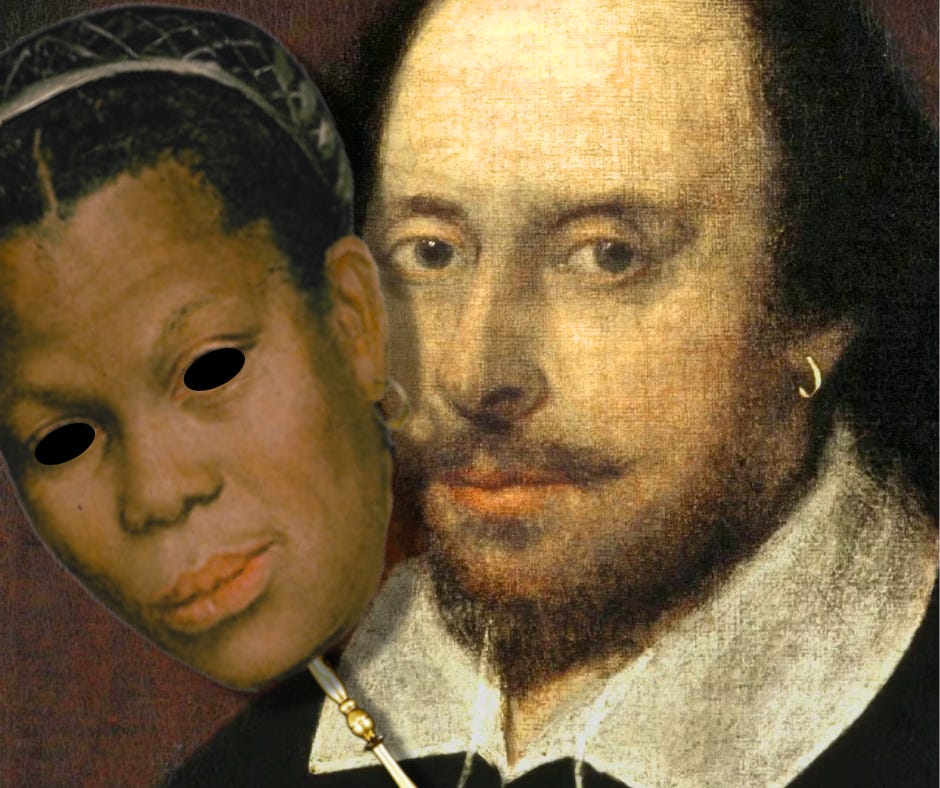
There’s nothing new about the Shakespeare authorship question. It’s been an obsession for centuries. The Victorians were especially fascinated with a variety of competing theories about who—other than the man from Stratford-Upon-Avon—could have written the greatest plays and poetry in the English language. The controversy persists to this day. The “Oxfordians” believe it was Edward de Vere, 17th Earl of Oxford; great classical actor Sir Derek Jacobi is a big proponent of this theory, which is featured in the 2011 film, Anonymous. There are those who think Shakespeare was written by Sir Francis Bacon; some champion rival playwrights like Christopher Marlowe (unlikely candidate, since he died in 1593, toward the very beginning of Shakespeare’s career). Some believe that Queen Elizabeth I herself wrote Shakespeare.
The justification offered by scholars and theorists who diss Mr. Shakespeare is rooted in pure snobbery. Shakespeare was the son of a glove maker and notorious village character who was always running afoul of the authorities. He was given a basic parochial education in a small town, and, unlike Marlowe and other of his contemporaries, never attended college. How could a lad from such humble beginnings, with such little formal education, pen such glorious plays and soaring poetry? Shakespeare was an itinerant actor. Where could he have acquired such a breadth of knowledge—from the law, to medicine, to classical mythology, ancient and modern history? The answer of course is he educated himself. He studied Holinshed’s Chronicles, like all his contemporaries, from which most of his British history plays were drawn; he read Sir Thomas North’s sensational translation of Plutarch’s Lives, which informed his Roman plays like Julius Caesar. Ovid's Metamorphoses inspired his mythologically themed plays, such as Troilus and Cressida.
Most significantly, from early on in his London career, Shakespeare had access to the most elevated center of culture and knowledge in which he might learn and observe: the royal court of Elizabeth I. His patron, the Earl of Southampton, for whom he wrote many of his Sonnets, was part of the Queen’s inner circle (until, of course, he got embroiled in Essex’s Rebellion). Shakespeare would have rubbed elbows with the most educated, cultured people in the world, no doubt picking the brains of elite doctors, scientists, lawyers, and his fellow writers to inform his works. It’s well known that most of the playwrights working in London collaborated with each other, and we know Shakespeare wrote plays with Christopher Marlowe as well as other leading lights of the day. No doubt each brought a wealth of knowledge and skill to the table, which further perfected Shakespeare’s craft.
I am, in the world of Shakespeare authorship, a confirmed “Stratfordian.” I believe that the Shakespeare we all know—the glove maker’s boy who made good—is the author of Shakespeare. I have been a passionate devotee of the plays and sonnets since childhood and my master’s degree is in classical theatre and Shakespeare. I’ve studied all of his plays and I’ve played 25 roles in the canon. He was lauded and celebrated in his lifetime; his patron was none other than the Queen herself. So beloved was he that upon his death, his fellow actors had his plays published in what we know as The First Folio, in a time when plays were not even considered literature and were rarely printed. The idea that he was a mere front man for some more elite genius is the stuff of fantasy, but it’s a fantasy that has beguiled generations of conspiracy theorists.
The latest such theorist is Irene Coslet, a self-styled “feminist historian,” whose book The Real Shakespeare: Emilia Bassano Willoughby is making some waves. Now, disclaimer: I haven’t read Coslet’s work. From the summaries and reviews I’ve seen, hers seems to be yet another of those snobbish discreditings of Shakespeare—the yokel with no college degree—in favor of a more sophisticated, cultured candidate from the Elizabethan court. This one, tantalizingly for those of the woke persuasion, is presented by Coslet as a black woman. A black Jewish woman, apparently.
Emilia Bassano is not an unfamiliar figure to those of us who’ve steeped ourselves in the Elizabethan and Jacobean eras in which Shakespeare lived. She was an exotic figure, a brilliant and ambitious woman, the mistress of Henry Cary, Lord Hunsdon, the Queen’s Lord Chamberlain—of The Lord Chamberlain’s Men—Shakespeare’s company of players, who would eventually, under the monarch’s patronage, become The Queen’s Men. Bassano has the distinction of being England’s first female professional poet, and the first woman in the British Isles to publish, in 1611. Her volume of poetry, Salve Deus Rex Judaeorum (Hail, God, King of the Jews), tells the story of the crucifixion of Christ from a woman’s point of view. It’s not surprising that Bassano is a fascination for Ms. Coslet, as she is widely considered, on the basis of this published work, to be an early feminist thinker. While Bassano and Shakespeare were close to the same age, her book was published a year after Shakespeare retired, having penned all 39 of his glorious plays. I’ve read some of Bassano’s book, and, well, I’ll just say this: she was no Shakespeare. There’s no evidence in her poetry of the genius of the Bard.
Was Bassano black and Jewish? Some historians call her Venetian, but she was born in England, to an English mother and Italian father, and baptized in London. There’s little evidence that she was of Jewish extraction. As for her being black, the primary basis Coslet has for this notion are some contemporary accounts which describe Bassano using the term “black,” which, at the time, was generally used to describe someone with a Mediterranean look: olive skin, dark hair and eyes. Being half Italian, Bassano likely displayed these attributes. Fair skin and hair were the ultimate in fashion in the Elizabethan age, not suprisingly, as these were the attributes of Elizabeth I. The Queen was the ultimate—in the Elizabethan Great Chain of Being she was second only to God—so of course, her pale skin and ginger hair were considered the ultimate in beauty. Extant paintings of Emilia Bassano show her as quite fair, with rich brown hair and eyes.
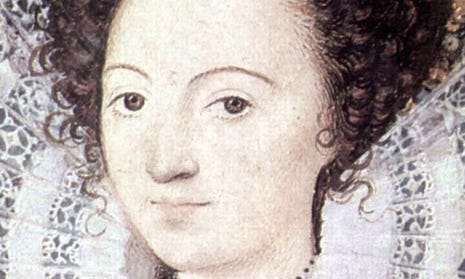
Bassano has featured in many fantastic accounts over the millennia. Some of her more romantic admirers believe that she might have been the “Dark Lady” of Shakespeare’s sonnets: the sexually alluring but cruel, unfaithful lover who tormented the writer. This is perhaps the most plausible of the legends of Emilia Bassano. She was certainly an alluring and sexually liberated woman for her time, the coveted mistress of the Lord Chamberlain, patron of Shakespeare’s company, and a brilliant and fascinating lady. The idea that she might have had a hot affair with Shakespeare isn’t out of the question. Having not read her book, I don’t know if Coslet credits Bassano with writing the plays and the sonnets—but the notion that she wrote the “Dark Lady” series of sonnets about herself is fairly incoherent.
My mistress’ eyes are nothing like the sun;
Coral is far more red than her lips’ red;
If snow be white, why then her breasts are dun;
If hairs be wires, black wires grow on her head.
I have seen roses damasked, red and white,
But no such roses see I in her cheeks;
And in some perfumes is there more delight
Than in the breath that from my mistress reeks.
I love to hear her speak, yet well I know
That music hath a far more pleasing sound.
I grant I never saw a goddess go;
My mistress, when she walks, treads on the ground.
And yet, by heaven, I think my love as rare
As any she belied with false compare.
William Shakespeare, Sonnet 130
The Queen and her physical attributes as the height of virtue and beauty in the Elizabethan Age, this poem describes the Dark Lady to paint her as the opposite—so she’s earthy, swarthy. “Dun” literally meant dusky, or olive skinned. May we infer an African hair texture from the description of “black wires” growing from her head? Perhaps…but who knows? Certainly up for interpretation, but there’s no way to prove it.
I will cease trying to debunk Ms. Coslet’s theories, however, having not done her the courtesy of reading her book first. From the summaries I’ve read, it appears her claim is that the historical narrative crediting Shakespeare has been shaped by Western-centric, Eurocentric, patriarchal, and racist historiography that has systematically erased the contributions of women and people of color. Coslet asserts that Bassano, a legitimate poet connected with the Tudor court and the literary circles of her time, ghost authored the works of Shakespeare because, as a woman, she was denied the opportunity to do so as herself. Well…this doesn’t explain the printing and publishing of her poetry in her lifetime, something achieved by only a handful of women in the era.
What seems clear to me is that Ms. Coslet’s narrative derives from today’s critical social justice and antiracist ideologies. Whether she makes a persuasive historical argument, supported by evidence, I don’t know, but I doubt that’s her primary goal. As a “feminist historian” I suspect her exercise is less about correcting the historical record and more about interpreting and revisioning history through a feminist lens. Coslet wants us to entertain the idea that Bassano could have been the author of Shakespeare, because women and people of color were suppressed and silenced in the past. Perhaps the patriarchy just did a great big coverup. But in an era dominated for 44 years by a powerful female ruler…? Hmm.
Mostly, I think, it’s the goal of ideologues like Coslet to “de-colonize the curriculum,” see: to “de-white-ify” the culture. To “de-center whiteness,” one must displace and discredit the great writers and thinkers of the past—the old dead white guys whose statues get toppled and whose works must be suppressed, butchered by sensitivity readers, and plastered with trigger warnings. Why not just rewrite history, and replace those men with figures that are female, black, queer, or other of the “marginalized?” This seems to be some misguided version of “reparations,” which involves the dismantling of history, and the deconstruction of the timeless works that have informed the very foundations of western culture.
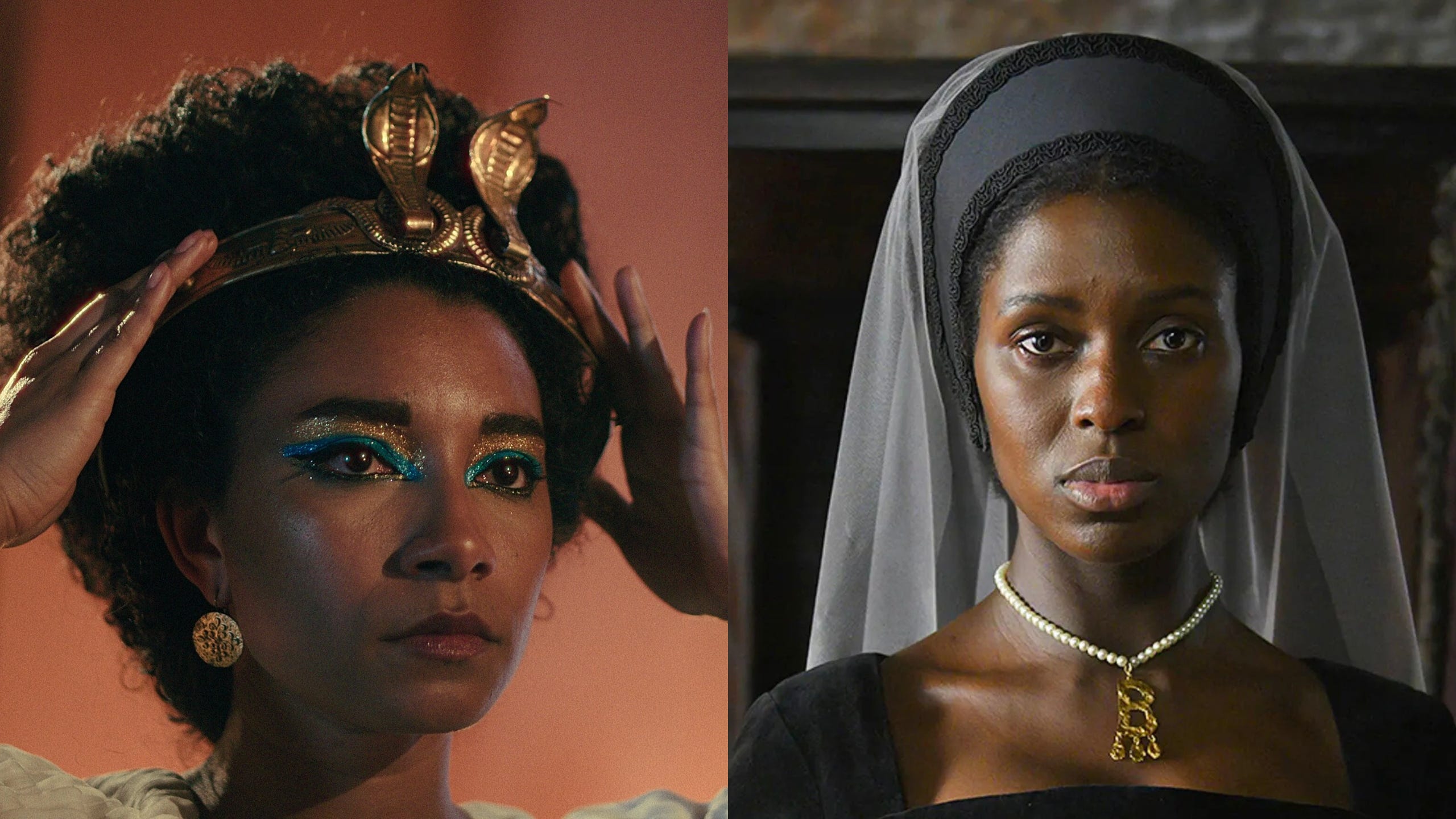
There’s been a pervasive fetish in the arts in recent years for “re-framing” historical narratives by race-swapping the roles of famous women of history. Jada Pinkett Smith caught heat for her docu-drama, Queen Cleopatra, in which she asserted that the legendary Egyptian monarch was in fact black, and that historians had it all wrong. The 2021 series Anne Boleyn cast black actress Jodie Turner-Smith in the titular role of Henry VIII’s doomed second wife. A bold move—considering that Boleyn was the mother of the famously not black Queen Elizabeth I. It was recently announced that trans influencer Dylan Mulvaney will be assuming the role of Anne Boleyn in the Broadway musical about the wives of Henry VIII, Six. Sigh. These, my friends, are the times we live in.
I have absolutely no problem with makers of theatre and film going off on interpretive flights of fancy, or riding cultural trends in an effort to be relevant, controversial, commercial. Sadly, such stunts as the ones I mention tend, ultimately, to backfire because, as open minded as audiences can be—and as a 35 year practitioner of theatre, I’ve enormous respect for audiences, and faith in their common sense and good taste—people tend to smell bullshit pretty quickly, and seek a core of truth in what they’re watching, no matter how fanciful it may be. Especially when based on history.
Shakespeare has been under attack for years now, along with many other of the titans of western literature and culture. There’s an abhorrent movement to “translate” Shakespeare into “modern” English, which is simply a dumbing down of the language to make it more “accessible.” I’ve got news for you: as Shakespeare was one of the creators of the English language—co-authoring the King James Bible, and coining words and phrases we all use today—he’s already accessible. It’s up to those who are teaching him, or speaking his 400 year-old words for an audience, to vigorously strive to make the language accessible. Yes, it’s archaic, and yes, 21st century listeners aren’t going to get 100% of it—but they can get the narrative essence and the beauty of its poetry.
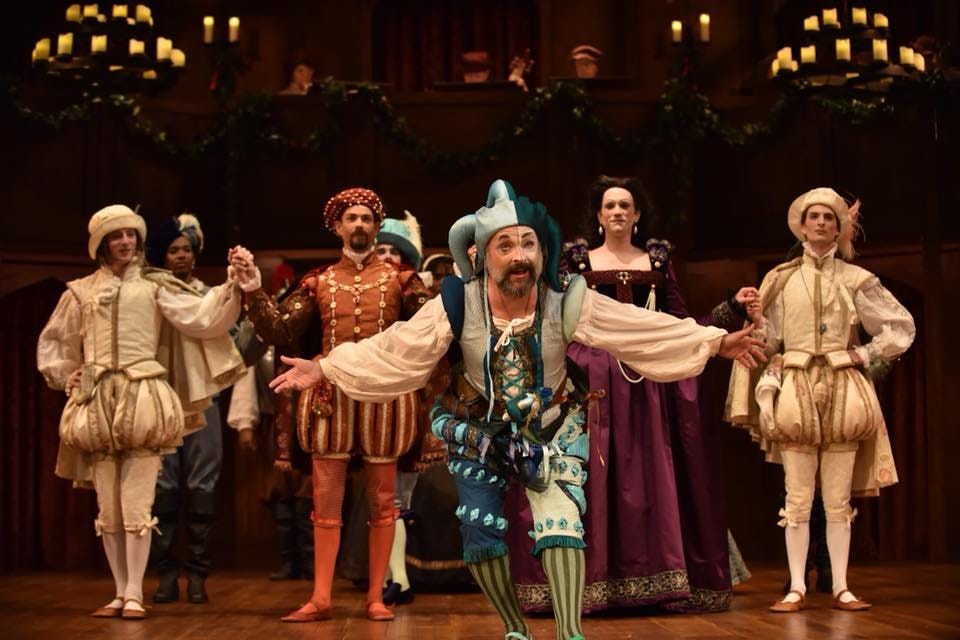
In 2017, I did the first ever American professional production of a Shakespeare play using Elizabethan stage practices with an all-male cast, performed in original pronunciation. Not only were we speaking archaic language, we were speaking it in an archaic dialect! But let me tell you, when we performed Twelfth Night at 10AM for bused in high school students at Orlando Shakespeare Theater, they were totally engaged, got everything, and loved it. We were performing a Shakespeare play as closely to the way it was originally done as possible—no tricks, no gimmicks, no light cues or special effects—and it thoroughly entertained and excited our “modern” audiences. Dumbing down the Bard is not the way to go, ever.
Last fall, on a trip to London, I went with friends to Shakespeare’s Globe—the gorgeous recreation of the Elizabethan playhouse—to see a production of Twelfth Night. I’d been to the Globe only once before, in 1997, and was lucky enough to have gotten a seat for the final performance of the theatre’s inaugural season: Henry V, starring then Artistic Director Mark Rylance. That production, done in Elizabethan style, was so electrifying for me as a theatre artist and bardolator, it changed my life. Last fall’s Twelfth Night was a travesty—a woke extravaganza of arbitrary “diversity” casting and “queer” shenanigans that had nothing to do with the piece, brought no new perspectives of value to it, and rendered the play’s story incoherent and its language unintelligible. We left at intermission.
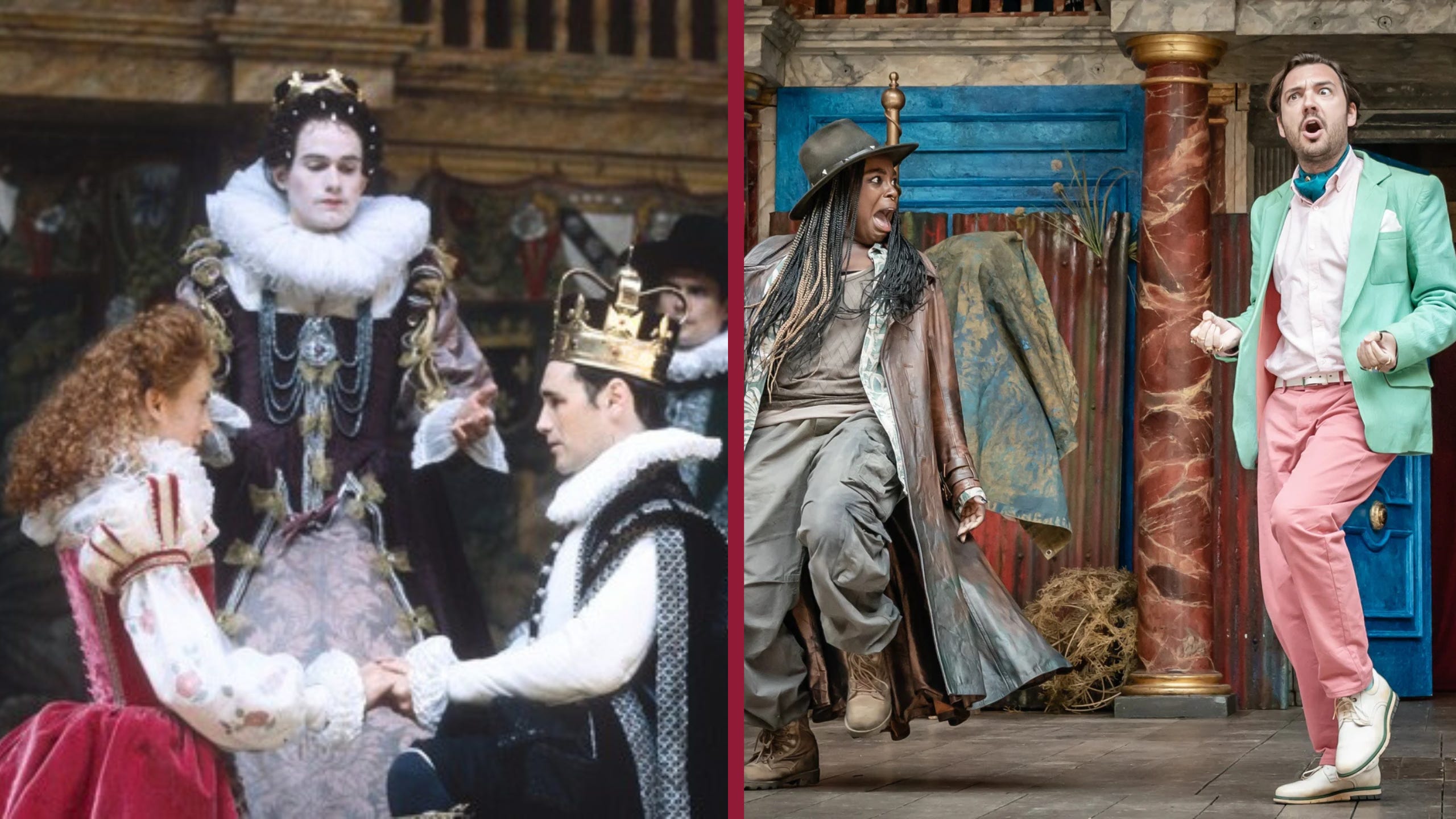
Now, don’t get me wrong—there were plenty of young people standing, as “groundlings,” in the London drizzle, at the edge of the Globe’s outdoor stage, who were eating it up, and loving every moment. And that’s great. Theatre is an interpretive art form, and there should be room for all kinds of expressions catering to all kinds of tastes. In his brilliant screenplay for All About Eve, Joe Mankiewicz has Bill Sampson, a Broadway director, lecture neophyte actress Eve Harrington with his populist philosophy about the theatre. His references are dated, but the sentiments are timeless:
Wherever there's magic and make-believe and an audience, there's theatre. Donald Duck, Ibsen and The Lone Ranger. Sarah Bernhardt and Poodles Hanneford. Lunt and Fontanne, Betty Grable. Rex the Wild Horse, Eleonora Duse, all theatre. You don't understand them all. You don't like them all. Why should you? The theatre's for everybody, you included, but not exclusively. So, don't approve or disapprove. It may not be your theatre, but it's theatre for somebody, somewhere.
Shakespeare is sturdy. There’s a reason he’s endured for over 400 years. His themes are universal, his human understanding profound. His plays have been interpreted in myriad ways by myriad cultures, from The Classical Theatre of Harlem to the films of Akira Kurosawa. These diverse visions should be celebrated. Joseph Papp, in my view the pioneer of modern classical theatre, presented a diverse vision of Shakespeare in Central Park nearly three quarters of a century ago—a tradition that the Public Theatre carries on to this day. William Shakespeare being a white guy from a small town in the 16th century hasn’t limited his appeal for audiences, or the freedom his works provide for interpretations that explore race, gender, politics and culture in each generation that discovers his genius. Trying to sell the fiction that he was, in fact, a she of color named Emilia Bassano adds nothing to our understanding of the works or their history—it merely panders to a particular audience hooked on the current ideological fads, which are rooted less in understanding and illuminating the foundations of Western culture than in “dismantling” and deconstructing them. Toppling statues. Not my thing, sorry. But you do you.
It’s interesting that Coslet’s book is coming out just as Hamnet, a critically acclaimed film about the marriage of Shakespeare and his wife Anne Hathaway, has received multiple Oscar nominations. The film centers on the couple’s loss of their 11 year-old son, and explores how this personal catastrophe inspired one of Shakespeare’s greatest works: Hamlet. It’s a terrific movie, not only rooted in the historical record, but in the understanding that William Shakespeare, the man from Stratford-Upon-Avon, authored the works of William Shakespeare. A story about a white, English couple mourning the death of their only son may not be to the tastes of intersectionalist feminists like Coslet, but it tells a story far more plausible than the one she’s peddling in her book, in the name of “de-colonization.” And it gives the most compelling and moving account of “Agnes” Hathaway ever offered, brilliantly performed by Jessie Buckley.
William Shakespeare, my dear Ms. Coslet, is a dead white guy whose works will outlive you and me, and endure forever. I know it, and he knew it:
Or I shall live your epitaph to make
Or you survive when I in earth am rotten.
From hence your memory death cannot take,
Although in me each part will be forgotten.
Your name from hence immortal life shall have,
Though I, once gone, to all the world must die.
The Earth can yield me but a common grave,
When you entombèd in men’s eyes shall lie.
Your monument shall be my gentle verse,
Which eyes not yet created shall o’erread;
And tongues to be your being shall rehearse
When all the breathers of this world are dead.
You still shall live—such virtue hath my pen—
Where breath most breathes, even in the mouths of men.
—William Shakespeare, Sonnet 81
It made me laugh so hard when I first read the Telegraph article about the book. I am pleased you have written a great rebuttal.
Good to read about the latest nonsense. These conspiracy theorists imagine that the secret of the real author was kept by a huge group of people. Ben Jonson, Shakespeare's friend and rival, eulogises him in the First Folio, and points out that his having "small Latin and less Greek" was no bar to his being the equal not of his contemporaries but of Aeschylus, Sophocles, and Euripides, and being "not of an age but for all time." Both he and Shakespeare's friends, Heminge and Condell, who published the First Folio, and all the members of his theatre companies, would have had to be in on this conspiracy. It's extraordinary that anyone could believe and write about and publish such nonsense. In addition to the education Shakespeare received in school (school at the time was nothing like school today; it provided a rigorous education, and he had teachers who were Oxbridge graduates), from the books he read, and at court, he learnt his art from other dramatists when he worked in the theatre. He affectionately quotes Marlowe in As You Like It. And, finally, he is an unparalleled genius. There is no accounting for genius. And this is where I differ from you with regard to Hamnet (about which I will soon publish an essay) and Shakespeare in Love. Imagination cannot be explained away by trauma. Ben Jonson lost a seven-year-old son and mourned him deeply as we know from the elegy he wrote (Shakespeare wrote no such elegy for his son) but Ben Jonson did not produce another Hamlet.